

EA Sports, through the official website, has released a Pitch Notes to explain in detail what has been changed in the gameplay of FIFA 21 with the release of the Corrective Patch 1.10.
In this article, we’ll be diving deeper into three gameplay changes around the further improvement to interception logic, the speed at which the ball travels following a Driven or Driven Ground Cross, as well as the accuracy of volleys hit with a fast moving ball.
With this TU, our intent is to further update FIFA 21 gameplay with changes based on your feedback, so let’s jump right in.
Further Interception Logic Improvement
Following a change to interception logic in the previous TU (TU 6), TU #7 looks to continue expanding on that change:
- Further improved interception logic in situations where the defending player is directly in the ball’s path.
- This change applies only in situations where the ball carrier is passing the ball.
The latest update to interception logic targets situations in which the defending player clearly steps between two attacking players and is directly present in the ball’s path. Let’s take a look at what we mean, but before TU# 7 was available.
Note how the defender is able to get into a decent position but is ultimately unable to get control of the ball with their foot, allowing the pass to get by them. Now let’s take a look at the same scenario but with TU #7 applied.
Potrebbero Interessarti

Now that TU #7 is in effect, you can see that the player is able to take control of the ball in this situation. They react to the ball with a little more urgency, control, and end up intercepting the pass. Our aim with this change is to ensure that players can feel confident about relying on interceptions in these types of situations, and for the act of intercepting to be more similar to its real world counterpart.
Note that this change does not mean every single interception will be successful, since every situation is different. In general, interceptions are harder to pull off with players who have lower defensive Attributes, so they’ll still be a significant challenge for players who aren’t very proficient at the defensive elements of football.
Volley Accuracy Following A Fast Moving Pass
TU #7 introduces the following change to volleys:
- Decreased how accurate a volley can be if the ball is reaching the shot taker at a high speed.
Volleys are a notoriously difficult shot type to successfully do in real life, and they can get even trickier if the ball is traveling with extreme speed.
To illustrate the impact of this change, here’s what 100 volleys, taken by a player with an 85 Volleys Attribute, could have looked like before TU #7, specifically with the ball traveling at a high speed towards the shot taker. The red lines indicate shots that would have missed the net, while the blue lines indicate shots that would have been on target, but may still be saved by the keeper.
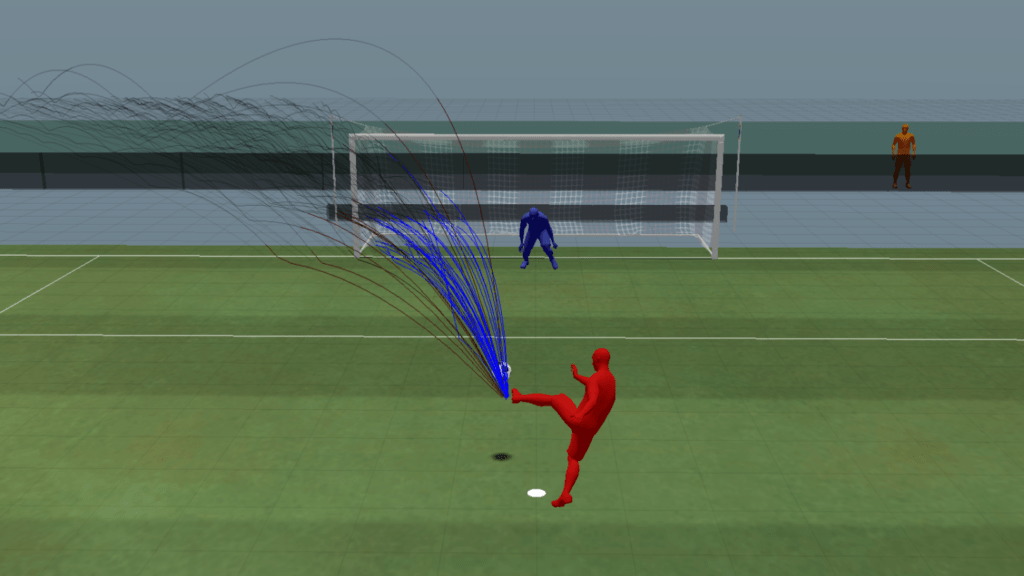
Now let’s take a look at another 100 volleys, by the same player and in the same scenario with TU #7 applied. Don’t forget, the ball is traveling at a very high speed before this volley is taken.
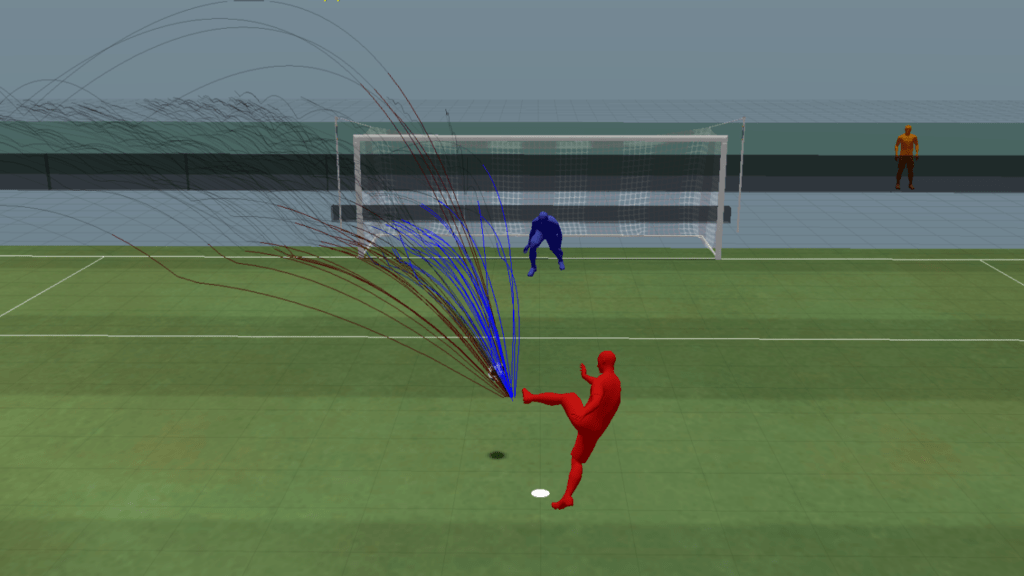
As you can see, the volley here is a little less accurate. This change has been applied in order to prevent volleys from becoming a tool that attackers over-rely on, especially as players continue to improve their squads in FIFA Ultimate Team. This change works in tandem with the one we’ll get to in just a moment, we want to maintain an authentic level of effectiveness of volleys from fast moving passes, which include some crosses.
Ball Speed Following A Driven or Driven Ground Cross
The speed at which the ball travels following a Driven or Driven Ground Cross has been updated through TU #7:
- Reduced the speed at which the ball travels when performing Driven or Driven Ground Crosses.
- This effect is most noticeable when performing a Driven or Driven Ground Cross with a player whose Crossing Attribute is 75 or lower.
- The higher the Crossing Attribute, the less pronounced this effect is.
In simple general terms, the better a player is at crossing the ball, the faster their Driven or Driven Ground Crosses can travel. What this change does is help ensure that players who are not known for their crossing technique produce Driven or Driven Ground Crosses that are in line with their Crossing Attribute.
The effect of this change scales based on the Crossing Attribute of the ball carrier, meaning that players with a low Crossing Attribute will be affected more than a player who has a 99 Crossing Attribute. What’s happening here is that we’ve increased the speed scaling effect between a 99 and a 75 Crossing Attribute. Although it was always present, this change has increased the impact of this scaling effect.
Crossing situations can vary greatly due to circumstances and player input, here’s a general sense how what you can expect from crosses after TU #7:
- Players with a 99 Crossing Attribute who attempt a Driven Cross will see the ball travel at generally 5% less speed.
- Driven Ground Crosses are not affected when the Crossing Attribute is 99.
- When the Crossing Attribute is at 75 or below, the ball will generally travel with 20% less speed following a Driven Cross.
- When the Crossing Attribute is at 75 or below, the ball will generally travel with 15% less speed following a Driven Ground Cross.
- These effects scale between 99 and 75 Crossing Attributes, meaning that the lower the the Crossing Attribute is for a player, the more impactful these effects are.
As mentioned before, our aim for this change to complement the volley-related one, in addition to providing a more authentic crossing experience.
FIFA 21 is expected in September, 2020 on PlayStation 4, Xbox One, PC, Nintendo Switch and presumably in December for the Next Gen PlayStation 5 and Xbox Series X platforms Keep on following us also through our social Facebook and Twitter for other news and information.